
HOME / MIXING SOLUTIONS / IN-TANK AGITATORS & MIXERS
In-Tank Agitators & Mixers
Mix, homogenise, incorporate and disperse powders and liquids using industrial in-tank mixers and agitators designed for your process.
Comprehensive range of stainless steel mixers
We supply a comprehensive range of stainless steel mixers and agitators, designed and manufactured to suit each process using advanced mixing and process technology.
Real-time software
Mixing simulation software supports real-time optimisation of mixing systems, helping to evaluate and improve process efficiency, processing time and energy use.
Innovative mixing solutions
Our mixing solutions support emulsifying, dispersing, suspending and blending, helping to reduce production time, improve efficiency and mass transfer, and increase production yield.
UZ-Type Agitator
UZ-type agitators provide efficient blending for a wide range of industrial applications.
Applications:
- Low- and medium-viscosity products.
- Dairy applications, including milk storage tanks and buttermilk.
- Food and beverage processes involving fruit juice, yeast, liquid egg and liquid sugars.

MAG-Type Impeller
Advantages:
This two-bladed, counter-flow impeller is designed for efficient mixing of highly viscous, non-Newtonian fluids. Opposing pitches on the inner and outer blades create upward and downward flow, mixing both the tank contents and the liquid surface.
The design combines strong circulation with low shear. Its large blade diameter and close clearance to the tank wall can provide up to four times the heat transfer of a standard turbine impeller.

Helical Ribbon Impeller
Helical ribbon impellers produce axial flow. An additional inner helix can pump in the opposite direction for high-viscosity mixing. Wall scrapers can be fitted to improve heat transfer and product uniformity when processing sticky materials.
Applications:
- High-viscosity products up to 25,000,000 cP.
- Chemical applications, including polymers.
- Food products, including creams and pastes.

Disperser
Advantages:
A high-speed sawtooth disc uses upward- and downward-pointing teeth to generate radial flow and a vortex that draws floating powder into the high-shear zone. Typical peripheral speeds are 15–20 m/s.
The teeth break up solids and disperse them into the liquid. Sawtooth impellers are suitable for products with viscosities up to 50,000 cP. Multi-shaft configurations can handle materials with viscosities of several hundred thousand cP.
Applications:
- Breaking up particles, agglomerates and powders to improve uniformity, mass transfer and dissolution.
- Coatings, inks, dyes, adhesives and chemicals.

Hydrofoil Turbine
Advantages:
Hydrofoil turbines provide efficient axial flow with low shear. Two to four tapered, twisted blades with cambered profiles produce high flow relative to power consumption.
Compared with pitched-blade turbines, streamlined flow and weaker vortices reduce shear and improve resistance to cavitation. The lower impeller weight permits longer shaft extensions for deeper tanks and helps address critical-speed limitations. Smooth surfaces and an open blade profile also support easy cleaning.
Applications: liquid blending and suspension of solids.

Marine-Type Propeller
Advantages:
This axial-flow impeller uses two to four blades and can be fitted with a circular guard. As it rotates, the propeller produces a helical flow pattern.
Configurations include side-entry installation in larger tanks and top-mounted installation in smaller tanks. Blade pitch can be varied to adjust pumping rate and thrust.
Applications:
- Low-viscosity fluids up to 4,000 cP.
- Blending, suspension, incorporation of solids and heat transfer.

Anchor Agitator
Advantages:
Anchor agitators are close-clearance impellers shaped to the tank contours. They provide mixing under the laminar-flow conditions found in high-viscosity applications and can be combined with other agitators. Where fitted, wall scrapers move material from the tank wall back into the mixture.
Applications:
- Liquids with viscosities of 5,000–100,000 cP.
- Thick but pourable food products, such as sauces.
- Chemical products, including paints, inks and adhesives.

Paddle Turbines
Advantages:
Paddle turbines typically use two blades at 90° for low-speed mixing. Blade angles of 60°, 45° or 30° can combine axial and radial flow. Their two-bladed design also supports installation in tanks with restricted access.
Multiple sets of paddles can be mounted on one shaft. A bottom steady bearing and intermediate supports can be provided where required.
Applications:
- Low- to moderate-shear and low-flow applications involving viscosities up to 10,000 cP.
- Blending and heat transfer.

Gate Mixers
Advantages:
Like anchor agitators, gate mixers closely follow the tank contours and mix viscous products under laminar-flow conditions. The impellers sweep near the wall and move material through direct contact.
Hinged scrapers can improve heat transfer and prevent high-viscosity products from adhering to the wall when low shear is sufficient. Gate mixers operate at low shaft speeds and can be used in atmospheric or pressure-rated tanks.
Applications:
- Liquids with viscosities of 5,000–100,000 cP.
- Food products, including yoghurts and soft cheeses.
- Chemical applications, including grease production.

Rotor–Stator High-Shear Mixer
Advantages:
A high-speed rotor operates inside a fixed stator to apply mechanical and hydraulic shear. At peripheral speeds of 15–30 m/s, the rotor blades pass the stator openings, breaking down particles and droplets and discharging material into the mixture. Fresh material is drawn in from below, supporting continuous flow and rapid particle-size reduction.
A solid/liquid injection manifold and a specially configured rotor–stator generate suction to draw solids through a separate feed tube directly into the high-shear zone, helping to disperse difficult powders.
Interchangeable stator heads allow the mixer to be configured for the application: a large-hole disintegration head for general mixing; a slotted head combining high shear and efficient flow for emulsions and medium-viscosity products; or a fine-screen head providing the highest shear at a lower flow rate for low-viscosity emulsions.
Applications:
- Particle-size reduction, homogenisation, dissolution, solubilisation, emulsification, grinding and dispersion.
- Viscosities up to 10,000 cP when used independently, or up to 200,000 cP when combined with an anchor agitator.
- Processes requiring rapid powder induction.

Rushton
Advantages:
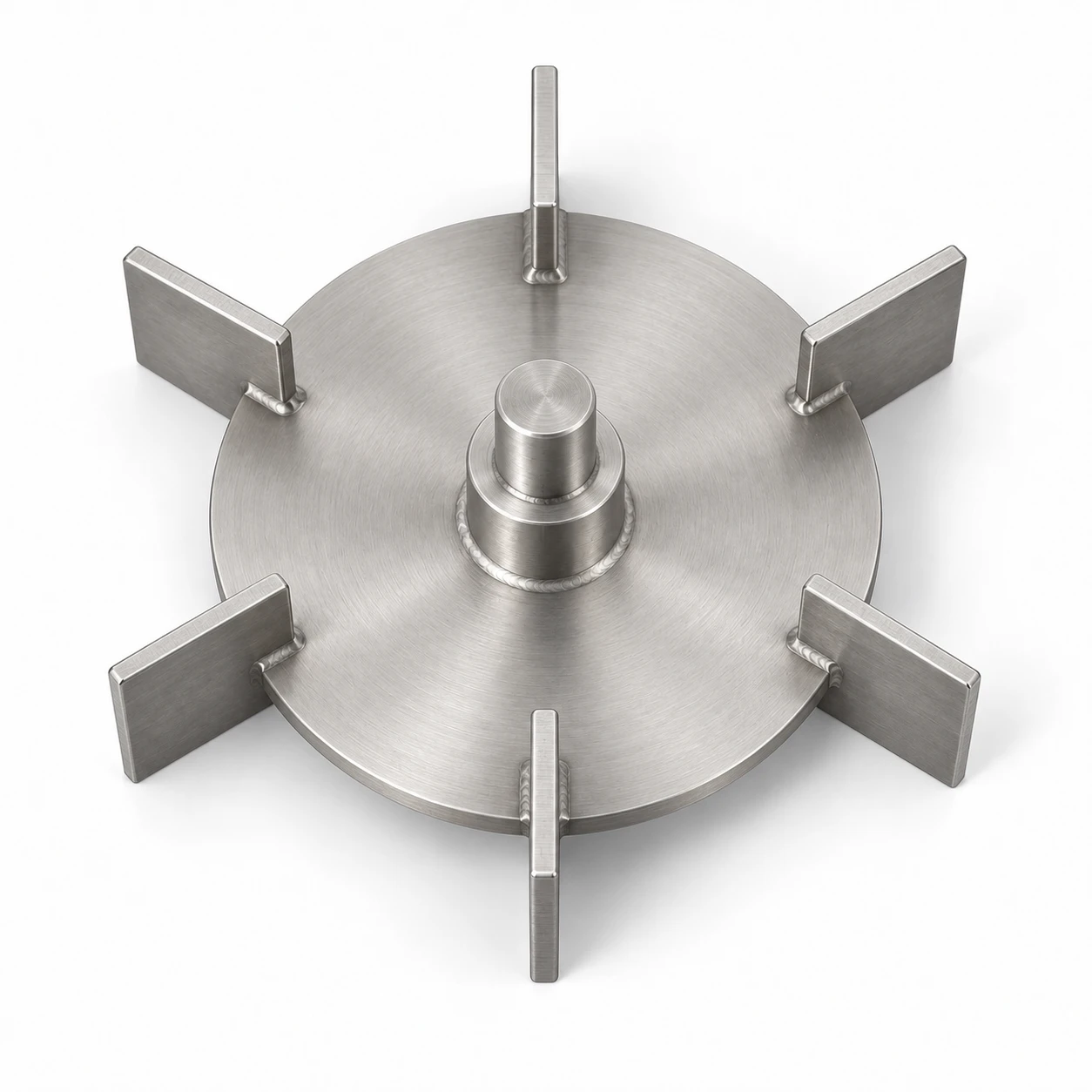
This flat-blade radial turbine has four or more vertical blades spaced evenly around a disc. Flow moves radially towards the tank wall, then divides upwards and downwards. With baffles, these streams create strong top-to-bottom circulation above and below the impeller.
Applications:
Suitable for gas–liquid and liquid–liquid dispersion where high shear and turbulence are required with a lower pumping rate. Applications include immiscible liquids, fermentation, gas dispersion, waste and fibre processing, and mixing at low liquid levels.
IBC Agitators with Folding Impellers
Advantages:
IBC agitators fit through a standard 150 mm screw-cap opening for resuspension, rehomogenisation, preparation and dissolution during storage or transport. Centrifugal force opens the impeller blades, which lock into position when fully extended.
Options include integral variable-speed drives, electric or pneumatic explosion-proof motors, and a stainless steel mounting bridge for secure attachment to the container frame.

Lifting Stands
Advantages:
Pneumatic and electric lifting stands simplify the use of agitators with mobile tanks by raising and lowering the mixing element into an open drum or tank. Stainless steel construction and designs suited to applicable safety requirements support dependable operation.
Applications:
- Fixed installations anchored to a solid floor or bolted to a steel structure.
- Mobile units with wheels, supplied with an agitator and control panel.
